
A year that began with a bang only to fizzle out in the end with car sales posting the steepest fall in nearly 11 years; a year marred by strikes -- 2011 will be one that the Indian automobile industry would like to forget in a hurry.

Two-wheeler exports from India fell by 17.8 per cent to 3.65 million units in 2022-23 (FY23), according to data released by the Society of Indian Automobile Manufacturers (Siam) on Thursday. This decline is due to a rise in global inflation and the weakening of economies and currencies in key export markets of Africa, Latin America (LatAm), and South Asia. In contrast to FY23, two-wheeler exports from India jumped 35.4 per cent to 4.44 million units in 2021-22 (FY22).

The company is willing to partner existing players; to begin with commercial vehicle launch.
A 30-member team of CEOs from leading Indian automobile components companies will be participating in a five-day orientation programme at Massachusetts Institute of Technology on product design and development.

According to the figures released by the Society of Indian Automobile Manufacturers, total exports from the country stood at 23,39,333 units in last fiscal compared to 18,04,426 units in the year-ago period.
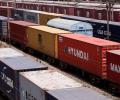
Indian Railways has managed to improve its freight volumes each year since the pandemic. However, its inability to add new industries and goods will pose a challenge for the national transporter in the wake of it setting an ambitious target of 45 per cent share in the national logistics by 2030. According to officials, the ministry of railways achieved 114 million tonnes (mt) of miscellaneous goods (classified as balance and other goods) in 2023-24.

Domestic car sales were down 33.4 per cent to 1,31,281 units last month as against 1,97,124 units in September 2018, according to data released by the Society of Indian Automobile Manufacturers (SIAM) on Friday.
The eighth Auto Expo kicks off on Thursday promising new launches and big announcements by domestic and global automobile giants, even as the booming industry sought flexibility in labour laws to maintain the growth momentum.

Maruti Suzuki India (MSIL) - the market leader in small cars - is eyeing the top spot in the sports utility vehicle (SUV) segment within a year - with a 33 per cent share of the pie. The company has been selling two SUVs - the Brezza and the Grand Vitara - and will start deliveries of the Jimny and the Fronx from March-end, and has set a target of growing its share from the current 11.5 per cent of the SUV market to 33 per cent by the end of 2023-24. The SUV segment is roughly about 42 per cent of the total passenger vehicle market, or around 1.3 million units.
The dynamics are changing as the sales pick up.

Despite multiple headwinds at the start of 2023, the Indian markets delivered a strong performance, posting 19-20 per cent growth for the year. Even as new records were set, investor sentiment remains strong going into 2024, given the lower inflation, expectations of steady to lower interest rates, higher economic growth, and strong inflows. However, the overriding concern for most brokerages is valuations.

The industry is engaged in a dialogue with the Government of India on policy measures which could minimise the impact of COVID-19 on the Indian economy and especially the domestic automobile industry.

The industry had witnessed a total sales of 12,63,293 units in August this year.
August 2010 proved to be a good month for most auto manufacturers.
Automobile companies have reported the highest ever monthly sales in India.

Domestic car sales were down 35.95 per cent at 1,22,956 units as against 1,91,979 units in July 2018, according to data released by the Society of Indian Automobile Manufacturers (SIAM) on Tuesday.
P Chidambaram has unveiled a bigger-than-expected outlay for the coming fiscal year.
Industry analysts say the display of mileage data will help buyers take informed decisions. "Studies conducted by us reveal this fact. Customers who were over-promised on mileage developed dissatisfaction that was four times higher than customers who were promised the actual mileage. So, the resultant transparency actually boosts the brand image of the car manufacturer," said Mohit Arora, senior director of Singapore-based JD Power and Associates.

Passenger vehicle exports from India increased 43 per cent in FY22, with Maruti Suzuki India leading the segment with dispatches of over 2.3 lakh units, as per the latest data by industry body SIAM. The total passenger vehicle (PV) exports stood at 5,77,875 units in 2021-22 fiscal, as compared to 4,04,397 units in 2020-21. Passenger car shipments saw 42 per cent growth at 3,74,986 units, while utility vehicle exports rose 46 per cent at 2,01,036 units during the last fiscal, the data by the Society of Indian Automobile Manufacturers (SIAM) showed.

Passenger vehicle wholesales in India declined nearly 4 per cent to 279,501 units last month, auto industry body SIAM said on Wednesday. Passenger vehicle (PV) dispatches from factories to dealerships in March 2021 stood at 290,939 units. As per the latest data by the Society of Indian Automobile Manufacturers (SIAM), two-wheeler sales also fell 21 per cent to 11,84,210 units as compared with 14,96,806 vehicles in March 2021.

Upbeat high-frequency indicators and consumer confidence show that Indian economy continues to forge ahead, emerging out of shackles of pandemic, said an article on the state of economy published in RBI Bulletin on Wednesday. The recovery is spearheaded by an uptick in private investment through November-December alongside a turnaround in bank credit offtake and high capex from the government sector (Centre and states). In conjunction, the employment situation has brightened, said the article written by RBI officials.

Domestic passenger car sales jumped by 39.48 per cent to 1,43,976 units in April. The figure for the corresponding month of the last year was 1,03,227 units.

Foreign Portfolio Investors' (FPIs) selling spree continues as they pulled out over Rs 3,400 crore from the Indian equity markets in the first three trading sessions of November on rising interest rates and geopolitical tensions in the Middle East. This came after such investors withdrew Rs 24,548 crore in October and Rs 14,767 crore in September, data with the depositories showed. Before the outflow, FPIs were incessantly buying Indian equities in the last six months from March to August and brought in Rs 1.74 lakh crore during the period.

If the concerns over risking political capital are overcome, the long-term gains for the Indian economy will be immense, asserts A K Bhattacharya.
According to the data release by the Society of Indian Automobile Manufacturers, car sales surged by 25 per cent in June 2004 over the same month last year. Take the Rediff Business Quiz and find out how much you know about the automobile sector.

'It leads to more investment, more money put in R&D, expansion and modernisation.'
Rising from a slowdown continuing for the past several quarters, Indian automobile makers are set to launch a record number of vehicles at the 12th edition of the Auto Expo from February 5.
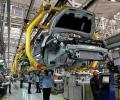
Automobile manufacturers are likely to report strong numbers for the September quarter of Financial Year 2023-24 (Q2 FY24), riding on growth across segments and offset by a marginal drop in overall two-wheeler (2W) volumes. Higher average selling price (ASP) year-on-year (YoY), which was necessitated by price hikes taken by original equipment manufacturers (OEMs), and an improved product mix will also aid revenues and margins. Moreover, commodity prices are down on a YoY basis, leading to higher margins in earnings before interest, taxes, depreciation and amortisation (Ebitda).

Major Indian automobile companies like Tata Motors, Bajaj Auto and Mahindra & Mahindra seem to have put up a robust performance in Q3 FY 10, paying advance tax of Rs 100 crore (Rs 1 billion), Rs 320 crore (Rs 3.2 billion) and Rs 195 crore (Rs 1.95 billion), respectively.
Rapid growth in the automobile industry has seen the market share of fake spare parts more than treble from 12 per cent to as much as 37 to 47 per cent in the past seven years.

Higher exports will also drive up volumes, as the company seeks to avail of the benefits under the government's recently announced production linked incentive scheme.
Automobile sales in January dropped 7.45 per cent, compared to the same month in 2008. Despite the decline, it is the first indication that the fall in sales, which occurred between October-December 2008, could be bottoming out and many hope for a recovery in February or March.
According to the data released by the Society of Indian Automobile Manufacturers on Monday, motorcycle sales last month went up marginally to 8,67,518 units from 8,67,088 units in November, 2011.
Vehicle sales across categories registered an increase of 4.99 per cent to 15,23,693 units from 14,51,263 units in February 2013.

Automobile dealers' body FADA said the Budget lacked immediate demand boosters for the automobile industry.
